For businesses with a website, online shop or web app
Low-maintenance privacy policies for your website
AI-based generator built on templates by a specialist IT lawyer. Fast and tailored.
- High quality: a template by Dr. Thomas Helbing that the AI adapts to your website where needed, instead of freely generated AI text
- Simple and fast: the AI examines your existing website itself, you only add what is missing and receive the result right away
- Low-maintenance: structured by topic rather than by tool, so a new tool or a change of provider less often requires new text
Free account · no subscription required
A service of matterius GmbH. Not a law firm, no legal advice.

Who is behind it
Developed by one of Germany’s leading data protection lawyers

„I have rethought website privacy policies: What are the pain points of privacy policies for websites? How can it be simpler? How do you avoid constant updates? The result now lives in the GDPR-Giraffe.“
Dr. Thomas Helbing
Specialist lawyer for IT law, Munich

- Handelsblatt “Germany’s Best Lawyers”, IT law and data protection law, 2020–2026
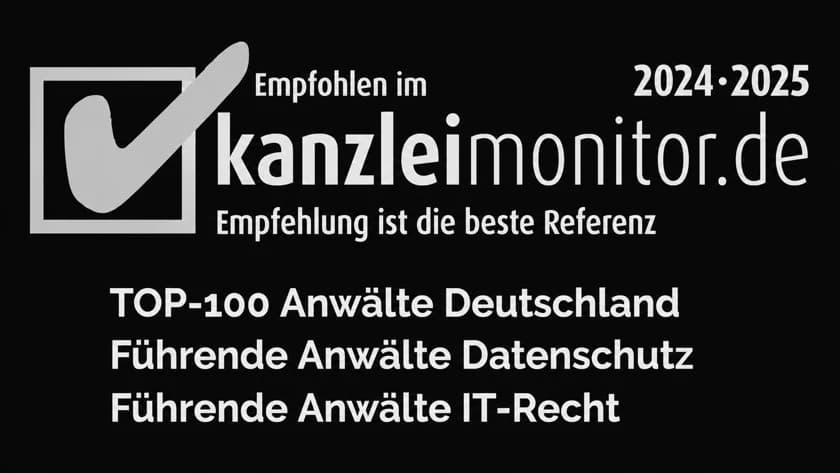
- Kanzleimonitor.de “Leading lawyers for data protection and IT law”, 2024–2026
- Kanzleimonitor.de “Top 100 lawyers”, 2024/25
The GDPR-Giraffe is a legal tech product of matterius GmbH, Munich. Its content was developed by Dr. Thomas Helbing. matterius GmbH is not a law firm and does not provide legal advice.
A service of matterius GmbH. Not a law firm, no legal advice.
Comparison
What the GDPR-Giraffe generator does differently
Data collection
Typical generator: Often you enter every service yourself
GDPR-Giraffe: The AI analyzes your existing website and suggests the services it finds
Structure
Typical generator: Often a separate text module per tool
GDPR-Giraffe: Topic blocks with consistent terms and a provider list, shorter and less often in need of updates
Foundation
Typical generator: Often a questionnaire that assembles text modules
GDPR-Giraffe: A specialist lawyer’s template that the AI completes based on the analysis and dialog, adding only where needed
Deliverables
Typical generator: Usually just the text of the policy
GDPR-Giraffe: Text plus notes on your case: open points, consent banner, data processing agreements, gaps in your previous policy
Scope
Typical generator: Usually just the privacy policy
GDPR-Giraffe: A comprehensive data protection AI: if you wish, it reviews the tools you use, such as newsletter or tracking, and derives the processing activities for your records
Before you buy
Typical generator: Content often only visible after purchase
GDPR-Giraffe: Free preview, buy only if you like it
Pricing model
Typical generator: Often a subscription model
GDPR-Giraffe: One-time price. Subscription only optional, embedded in a comprehensive data protection tool rather than an isolated generator
Provider and review
Typical generator: Not always clear who the provider is and what review is included
GDPR-Giraffe: Clearly labeled legal tech product. A lawyer’s review is optional and available separately from the HELBING law firm
The comparison describes typical features of common document generators and does not refer to any specific provider.
A service of matterius GmbH. Not a law firm, no legal advice.
Price
Pay once, use it for good
Website privacy policy
€149
one-time · net plus VAT
- Privacy policy with an annex of recipients
- Explanatory notes with the open points for your website
- No subscription required
- Free preview before you buy
- Available immediately after purchase
- Download as Word (.docx), PDF and Markdown
A service of matterius GmbH. Not a law firm, no legal advice.
This offer is aimed exclusively at businesses.
Optional: if you want to use the Giraffe regularly for further data protection topics, you can take out a subscription. It is not required for this work result.
Low-maintenance
What makes the privacy policy low-maintenance?
Many privacy policies have a separate block of text for every tool. Then every new feature and every change of provider means new text. This privacy policy is structured differently.
Topic blocks instead of a text module per tool
The policy is organized by topic, for example:
- server operation and embedded content
- contact form, newsletter and user account
- sale of goods and services
- analytics and marketing
An additional tool often fits into an existing block without new text.
Categories in the text, providers in a list
- The GDPR requires “the recipients or categories of recipients” (Art. 13(1)(e)).
- The text therefore names categories such as hosting or newsletter providers.
- The specific providers are listed in an annex, with their country and the basis for any international transfer.
If you switch providers, you change one line in the annex, not the text.
Shorter and easier to understand
- Consistently defined terms for data types, purposes and legal bases
- No repetition for every single tool
- Limited to the mandatory information the GDPR requires
Just as Art. 12(1) GDPR demands: concise, transparent, intelligible and easily accessible.
A service of matterius GmbH. Not a law firm, no legal advice.
How it works
Three steps to your result
Sign up for free
Create a free account with the GDPR-Giraffe. The matching use case opens right after you sign in.
Enter the address, answer questions
The AI examines your website, suggests the services it finds and only asks for what it cannot find out itself, such as retention periods. If the website is not online yet, it collects everything in the dialog.
See the preview, buy if you like it
You see the result first as a free, partly redacted preview. Only if it fits do you buy it and download it right away.
A service of matterius GmbH. Not a law firm, no legal advice.
FAQ
Frequently asked questions
A service of matterius GmbH. Not a law firm, no legal advice.
Knowledge
Website privacy policies: what matters in practice
Practically every website needs a privacy policy, because the server already processes the IP address when a page is called up. Here are the key points for operators of company websites, shops and web apps.
Mandatory information under Art. 13 GDPR
When data is collected from visitors themselves, the controller must provide information at the time of collection (Art. 13 GDPR). On a website, that means with the first page view at the latest. In particular, the privacy policy states:
- the name and contact details of the controller and, where applicable, of the data protection officer and an EU representative
- the purposes and legal bases of each processing operation and, for legitimate interests, those interests
- the recipients or categories of recipients
- transfers to third countries and their basis
- the retention period or the criteria for it
- the rights of visitors, including withdrawing consent and lodging a complaint with the supervisory authority
Recipients: categories or names?
Art. 13(1)(e) GDPR requires “the recipients or categories of recipients”. Categories such as “hosting providers” therefore satisfy the wording. The supervisory authorities’ transparency guidelines (WP 260, endorsed by the EDPB), however, treat naming the actual recipients as the default and require categories to be as specific as possible. The right of access is stricter: on request, the actual recipients must in principle be named (CJEU, judgment of 12 January 2023, C-154/21).
A hybrid structure combines both: the text names the categories, and an annex lists the providers actually used. The text stays stable, and the provider list stays complete.
Privacy policy and cookie banner
Two sets of rules apply side by side. The GDPR governs the processing of personal data. Access to the user’s device, meaning setting and reading cookies and similar technologies, is governed by the ePrivacy rules (Art. 5(3) ePrivacy Directive, in Germany § 25 TDDDG), regardless of whether personal data is stored. Consent is required unless the access is strictly necessary to provide a service explicitly requested by the user.
The banner therefore typically obtains both consents together. The privacy policy describes the processing operations and the types of consent. The cookie information with the name, purpose and duration of individual cookies belongs in the consent tool. What matters is that banner and website match: if a service already loads before consent, even the best text will not help.
When does the policy need updating?
The policy must reflect the actual state of the website. Typical reasons for an update are:
- new features such as a newsletter, shop, customer account or chat
- new or changed service providers, for example for hosting, analytics or payments
- newly embedded content such as videos, maps or fonts
- changed retention periods or a new data protection officer
- changes in the law, for example on international transfers
Common mistakes
These weaknesses come up particularly often in practice:
- a copied policy that does not match your own technology
- forgotten services, especially embedded fonts, maps, videos and captchas
- analytics and marketing tools that load before consent
- providers that were replaced long ago, while new ones are missing
- blanket legal bases not assigned to the individual purposes
- a vague retention period such as “as long as necessary” without criteria
- processors named in the policy without an agreement under Art. 28 GDPR
US services and the Data Privacy Framework
Many website services come from US providers, for example for analytics, advertising or videos. Since the European Commission’s adequacy decision of 10 July 2023, data may be transferred to US companies certified under the EU-US Data Privacy Framework (DPF). The privacy policy must still mention the transfer and its basis (Art. 13(1)(f) GDPR).
Without certification, or if the recipient is in another third country without an adequacy decision, standard contractual clauses are usually required. The public DPF list shows whether a provider is certified. The status can change and should be checked regularly.
Warning letters and fines
A missing or incorrect privacy policy breaches the information obligations. Supervisory authorities can impose fines of up to EUR 20 million or 4% of worldwide annual turnover under Art. 83(5)(b) GDPR. Data subjects can lodge complaints and, under the conditions of Art. 82 GDPR, claim damages.
Whether competitors can take action against data protection breaches was disputed for a long time. The CJEU has ruled that the GDPR does not preclude competitors from suing under national unfair competition law (judgment of 4 October 2024, C-21/23). Cases where the text and the website clearly diverge, such as tracking without consent, are particularly exposed.
Placement and accessibility
The policy must be easily accessible (Art. 12(1) GDPR). Proven practice includes:
- a clearly labeled link such as “Privacy” on every page, usually in the footer
- a reference where data is collected: contact form, newsletter sign-up, checkout and cookie banner
- a separate page, not hidden in the imprint or the terms and conditions
- the language of the website: if you address English-speaking visitors, offer the policy in English too
What the GDPR-Giraffe’s privacy policy includes
- General information: controller, where applicable data protection officer and EU representative, structure of the policy
- Topic blocks depending on your website: technical operation (server, CDN, captcha, embedded content), features such as contact form, newsletter, chat, user account and sales, analytics and marketing
- Supplementary information on purposes, legal bases, retention, recipients and international transfers, definitions of terms and the rights of visitors
- Annex of recipients: the providers used, with their country and the basis for any international transfer
- Explanatory notes for you as the operator: open points before publication, such as required data processing agreements, consents in the cookie banner, services that load before consent and deviations from your previous policy
Get started
Create your website privacy policy now
Sign up for free, answer the questions, see the preview. You only buy what convinces you.
Create your privacy policyA service of matterius GmbH. Not a law firm, no legal advice.